By Marissa Banuelos and Havalin Haskell
In 1992, the United Nations Framework Convention on Climate Change (UNFCCC) declared its mission.
“The ultimate objective of this Convention and any related legal instruments that the Conference of the Parties may adopt is to achieve, in accordance with the relevant provisions of the Convention, stabilization of greenhouse gas concentrations in the atmosphere at a level that would prevent dangerous anthropogenic interference with the climate system. Such a level should be achieved within a time frame sufficient to allow ecosystems to adapt naturally to climate change, to ensure that food production is not threatened and to enable economic development to proceed in a sustainable manner.” (UNFCCC 1992; italics and bold added for emphasis).
Thirty-three years after the establishment of the UNFCCC, 10 years after the Paris Climate Agreement, and 30 COPs later, progress has fallen short of this objective by magnitudes. As disappointing and deadly outcomes compile over COP after COP, one must ask: Why has the UNFCCC not achieved its “ultimate objective”?
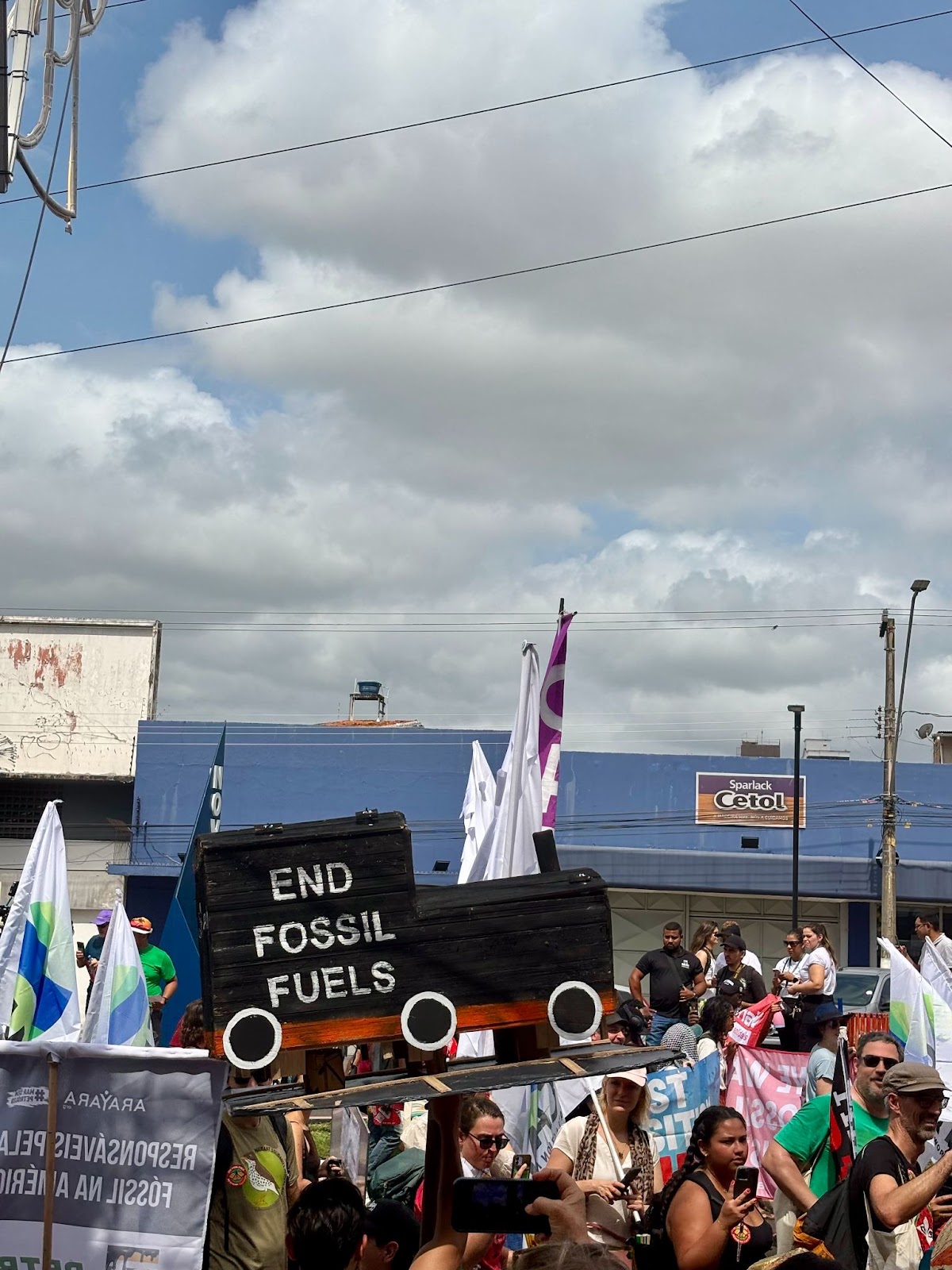
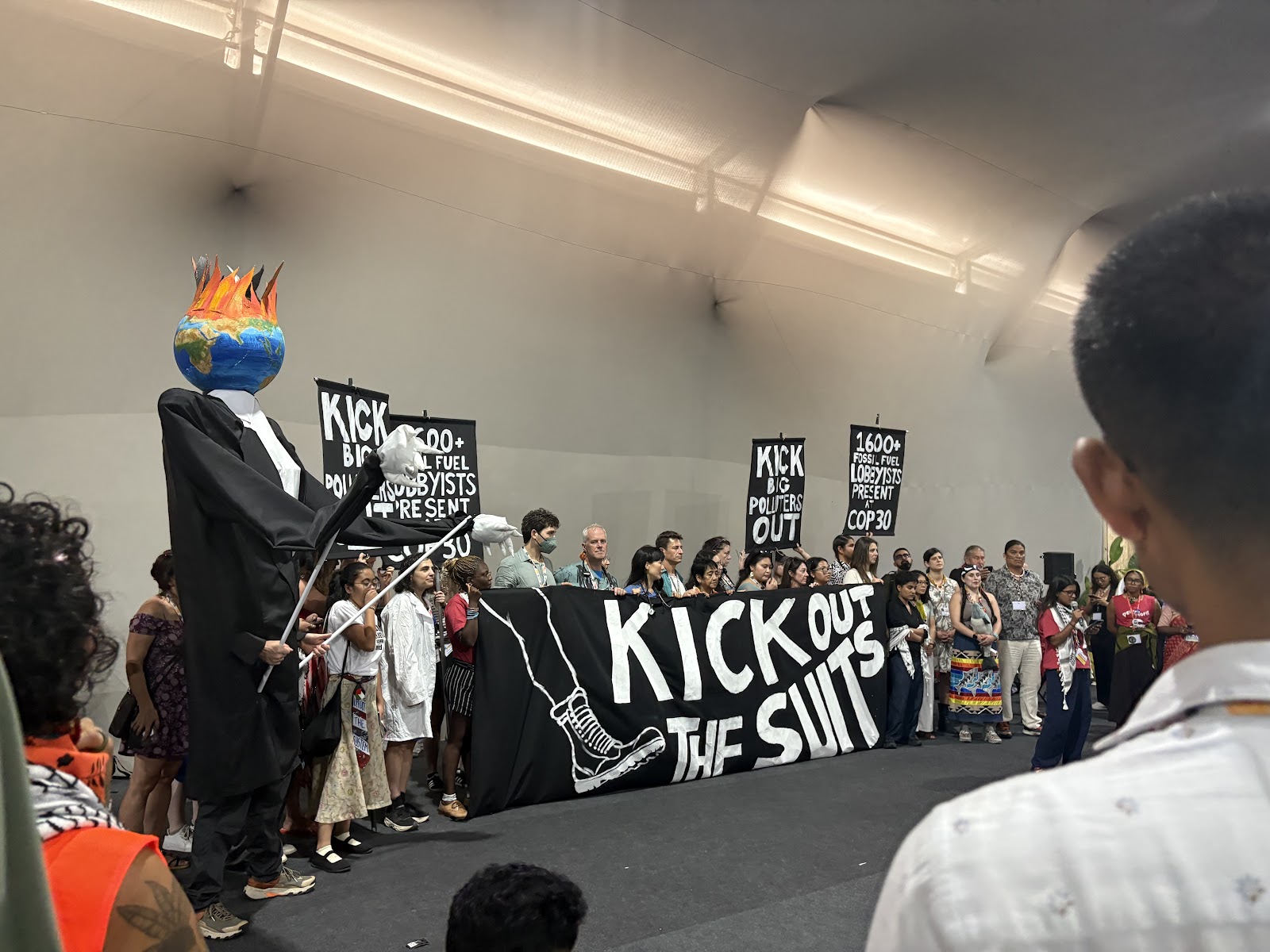
The halls of COP30 bustle with people- climate activists, advocates, negotiators…and fossil fuel lobbyists. This COP marks the record number of fossil fuel lobbyists, numbering at 1,600. That means 1 out of 25 participants at COP. Alongside them are 531 carbon capture and storage (CCS) lobbyists.

Why does that matter? These fossil fuel and carbon capture actors work to obstruct climate action and ambition in novel ways each year. Here’s an example:
The Center for International Environmental Law argues that the fossil fuel industry and CCS lobbyists are taking advantage of the recent AI boom, and the associated increased energy demand, to expand the fossil fuel industry. This expansion is being justified by carbon capture technology.
In an interview, a man who works in the carbon market sphere shared with Riss that, “[carbon credits are] the best option we have within our current system.” He conceded that some solutions are worse than others. Still, he argued that there is vast potential for emission reduction, ecological conservation, and restoration.
Do his words ring true though? Is resistance to this technology mere skepticism?
In 2024 Nature found that 88% of carbon sequestration and storage (CSS) projects fail. According to a report from Oxford University Smith School of Enterprise and the Environment, CCS may be “highly economically damaging” and cost upward of 30 trillion USD more than renewable, energy efficient, and electrification pathways by 2050.
This amounts to 1 trillion dollars per year- the very difference between the finance promised at COP29 and the finance needed to fund mitigation, adaptation, and loss and damage, the major, woefully underfunded, agenda items within the UNFCCC.
Still the tentacles of the fossil fuel industry extend beyond a startling presence and likely obstruction to ambitious policy outcomes. While the COP30 Presidency didn’t praise oil and gas as “a gift from God” like the COP29 Presidency; they followed the footsteps of the COP28 presidency, selecting a prominent fossil fuel-oriented PR firm, Edelman, to effectively craft the public narrative around the conference.
Edelman earns more revenue from fossil fuel clients than any other PR company of its size. They represent major players like Shell and Exxon, and have helped shape campaigns that influence policy to maintain access to drilling on U.S. federal lands.
And, as well as its past work with some of the world’s biggest fossil fuel companies, Edelman previously developed a “communications strategy” and message “playbook” for a trade group representing major players in the Brazilian soy industry and a major trade group accused of lobbying to roll back measures to protect the amazon from deforestation.
Who better to shape the narrative about ending fossil fuels than the experts who’ve spent decades greenwashing the narrative?
A group of prominent climate communicators and creators recently signed an open letter calling out the contradiction of hiring Edelman to handle COP30’s communications. The letter urges the COP30 Presidency to safeguard information integrity and ensure that public updates are accurate and unbiased- untainted by fossil fuel interests.
Yet, the decision to hire Edelman is a reminder of how deeply fossil fuel influence, whether overt or subtle, continues to shape the narratives, priorities, and outcomes of these negotiations. It’s a small detail, but one that reveals the enduring tension between climate action and the forces working to slow it.
The irony deepens, because one of the official themes of COP30, for the first time, is information integrity. In his opening statement at the beginning of the conference on Monday, the COP30 President Pedro Aranha Correa do Lago labeled this COP, the “COP of Truth,” calling for combating disinformation as a cornerstone of effective climate action.
More than ever, researchers and climate communicators are pointing out the interconnected nature between disinformation and climate change- largely driven by the fossil fuel industry.
Kate Cell, a senior leader at the Union of Concerned Scientists, put it plainly when we chatted after a press conference on a book release on climate obstructionism: “The two crises facing humanity are the climate crisis and the crisis of disinformation — and that is widely recognized.” She pointed us to the World Economic Forum, which has consistently identified both as defining global risks.
On Saturday, we got to hear directly from the “entire United States federal delegation to Brazil:,” consisting soley of Senator Whitehouse from Rhode Island . He has been, and will be the only federally elected representative here at COP30, as other would-be congressional attendees were held back by the vote to end the government shut-down. He spoke candidly about this very nexus between climate change and dis-/mis- information, specifically as it relates to the “malevolent presence of the fossil fuel industry” within climate governance, in both the US and at COP.
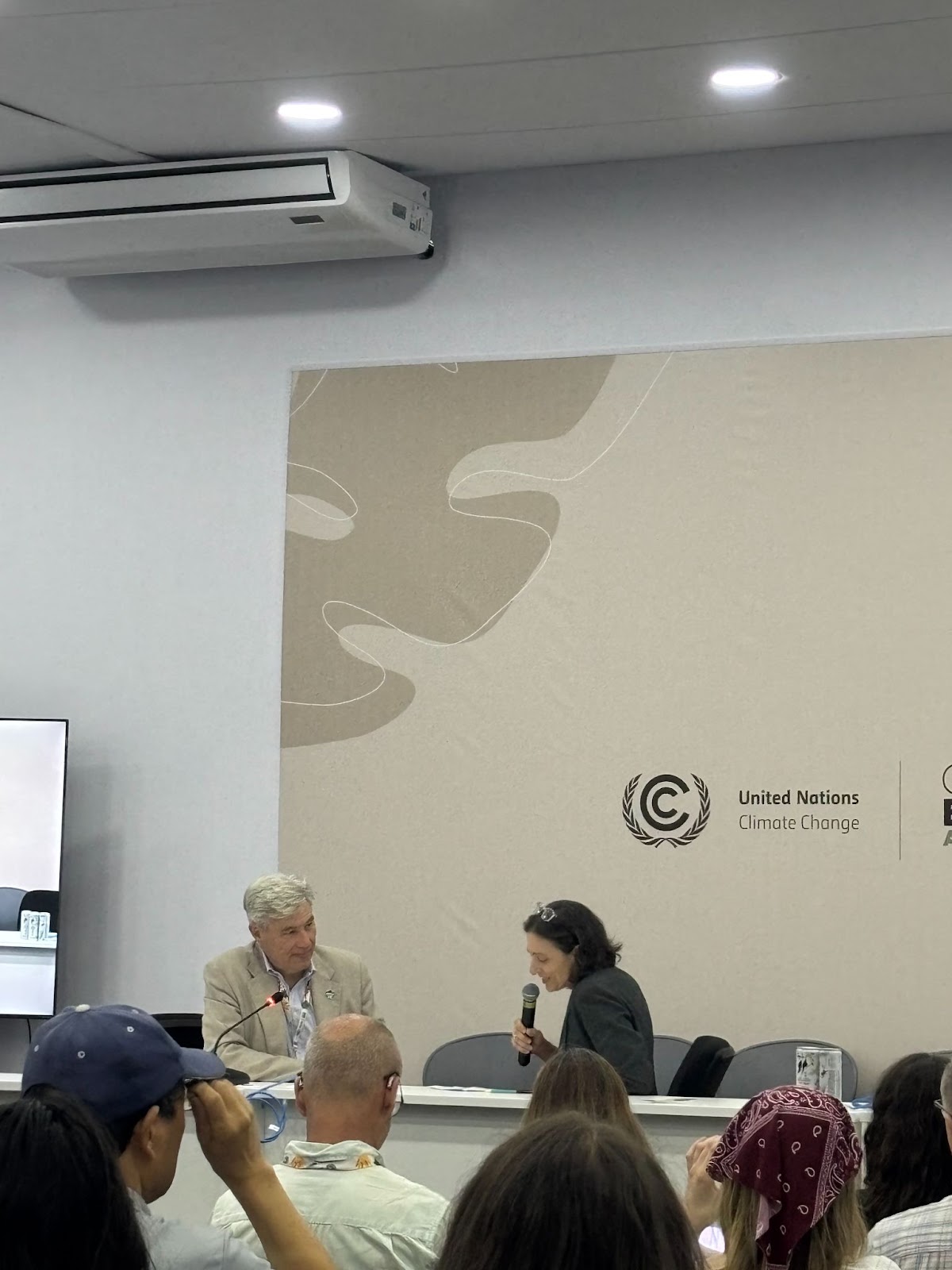
“At the heart is a failure of governance driven by corruption, disinformation, and insidious political influence by the fossil fuel industry,” he said. “Here [at the UN Climate Summits] they show up in smiling masks; in my sphere they are absolutely malevolent.” He labeled Trump as the “true face of the fossil fuel industry,” which is largely behind the dismantling of our true democracy.
Senator Whitehouse’s last remarks really stuck with us.
“We need to call this a story that has villains in it.” We need to call out who the villains are in this story.
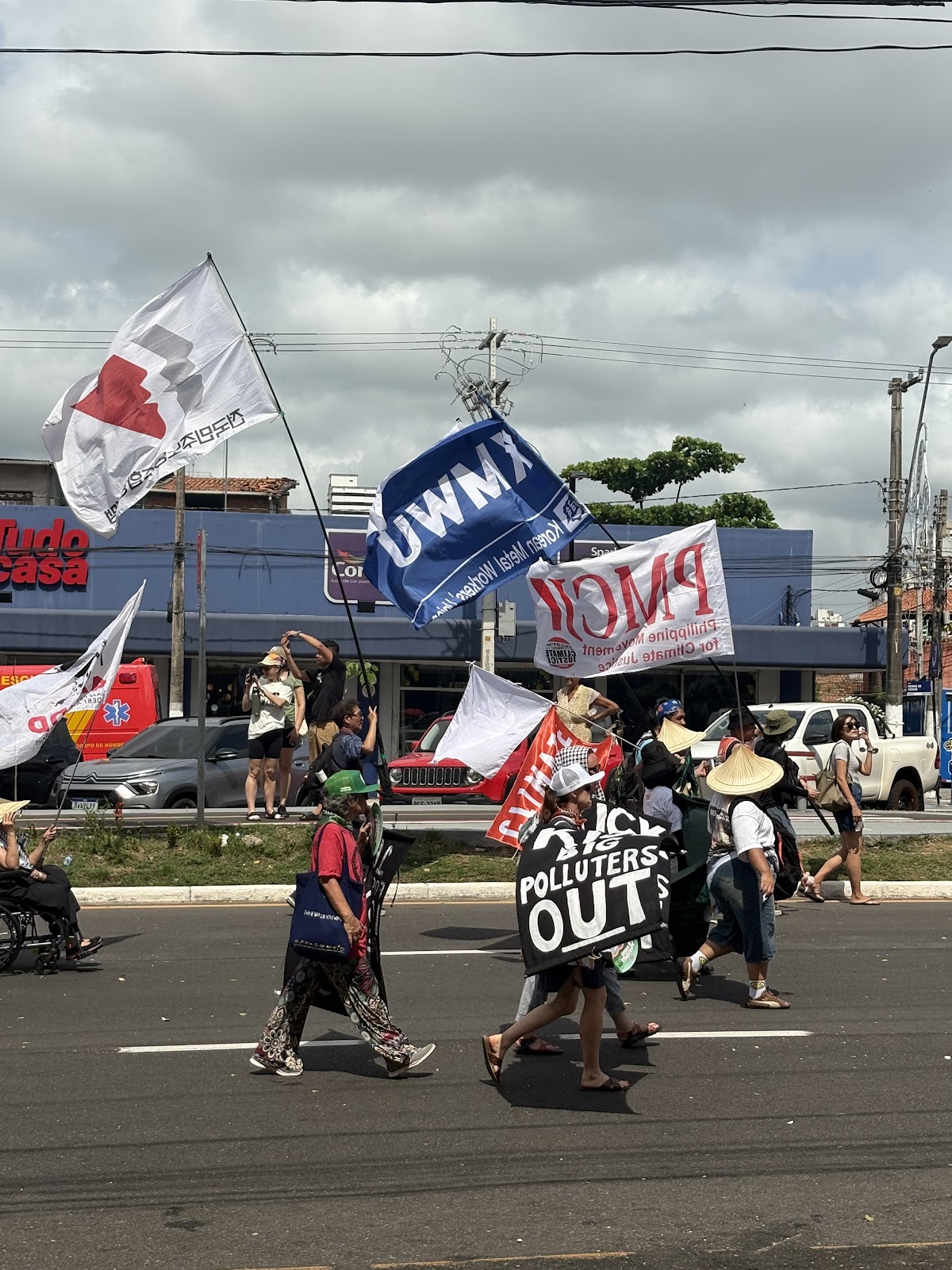
Kick Big Polluters Out is doing just that through protest, side events, and in talks with secretariats. They are working to reform UNFCCC policy to ensure these “villains” can no longer interfere with climate action.
Kick Big Polluters Out, through their creative and courageous advocacy has begun to move the needle. Now, non-state COP participants must disclose their funding sources. Still, there is more work to be done. Many fossil fuel and CCS lobbyists attend with “ party” badges, awarded by signatory countries.
At a panel entitled Protect, Reform, Deliver: Removing the Stumbling Blocks, Blocking Progress in Climate Action. Rachel Rose Jackson shared that UNFCCC doesn’t have a conflict of interest policy, or a definition for it. Despite this, countries that represent 70% of the population have called for conflicts of interest to be addressed. Another panelist, Leah Temper shared lessons learned from World Health Organization (WHO) conferences.
WHO requires conflict of interest disclosures that make commercial influence visible. Both internal staff and external experts have to disclose anything that may be perceived as a conflict of interest, including being entangled in the tobacco and weapon industries. The UNFCCC does not require this transparency for fossil fuel industries and this, she says, is why progress is so slow.
How does it make sense to include the people causing the problems an institution is trying to mitigate? Especially when they are responsible for vast disinformation campaigns that have effectively stalled action for decades?
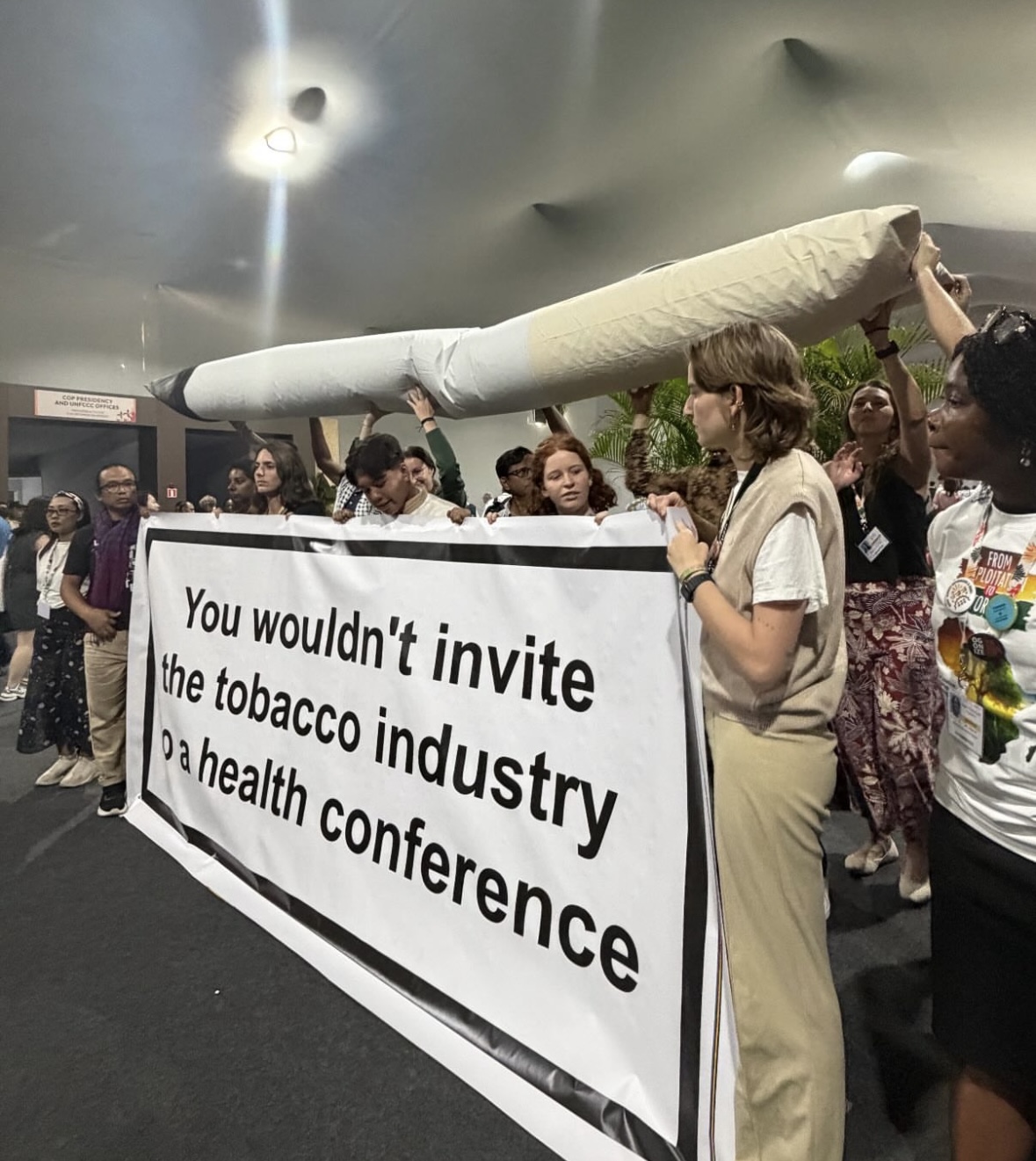
At the same side event mentioned earlier, Batool Zaidi left us with a powerful call to policy change. To exclude the villains from the process, the UNFCCC must:
- As a first step, call on nations to create their own conflict of interest policies for their party badges and regulate their own delegations to COP.
- Ask that states create a conflict of interest definition and policy within the UNFCCC recognizing vested interests are a fundamental obstacle and that they must support a robust accountability framework.
Zaidi was careful not to leave us without homework. As civil society representatives, we must amplify awareness and policy change within our home countries toward transparency and accountability.
Fossil fuel industry villains, the creators of the biggest threat to humanity, must be removed from influential positions in policy. Without this systemic change, it will prove difficult or impossible to mitigate the worst effects of the climate crisis. Thirty COPs and 10 years after the Paris Agreement, there is no more time to be wasted by obstruction tactics bolstered by the fossil fuel industry. The UNFCCC must create a conflict of interest policy guided by its mission statement from 1992. We must speak truth to power, naming the villains that inhibit progress and demand changes to the process.