Introduction
As a senior at Colorado College with an Independently Designed Major in Ecological Urban Studies, I am forming my thesis research around the intersectionality of third-places (places distinct from home and school/work) and urban ecology. I view improving biodiversity as a key driver for urban habitability, and also as integral in addressing the growing concerns in our global food system, biodiversity loss, and the climate crisis. My academic and soon-to-be professional interests brought me to the COP30 in Belém, Brazil, where I focused on the role of cities and urban governance in addressing a wide range of topics centered around reducing emissions and building resilience through biodiversity and food system transformations.
I found that cities and other subnational level groups such as states/provinces/counties, NGOs, and private businesses can greatly benefit from international collaboration, and lead transitions away from fossil fuels towards low-carbon pathways in order to stay within the 1.5 degree Celsius limit made in the Paris Climate Agreement in 2015. In my class leading up to COP30 as well as when I was there, I explored more ways that cities can play a strong role in these transitions through shifts within the agricultural sector for restoring biodiversity. The linkages between urban and rural sites are inseparable, therefore current global climate action can accelerate not only through subnational collaboration, but also by centering agroecological values throughout landscape planning/development. Other COP30 attendees and I view it necessary for all cities and local governments to develop their own sustainability/climate action plans in accordance with the Paris Agreement, and for these plans to include biodiversity commitments that incorporate both an urban ecology and food systems approach.
Questions, Methods, Approaches
My current senior thesis project around third-places helps me focus on both inter-species and urban strategies for the climate crisis, which drove me to attend side events and have conversations at COP30 about urban and agricultural themes (see my first blog on third-places here). I also planned to spend time at the thematic and national pavilions to gain a further view into the general conversations around my topics of interest. During my one week at the conference I spent a majority of my time at side events, pavilions, and finding food, with moments of conversations throughout the day. I attended a few negotiations and also sat at my college’s co-created exhibit with other Colorado schools and Youth Environmental Alliance in Higher Education (YEAH) delegates.
I entered the conference with the main focus of finding local and municipal leaders, and observing/researching their priorities and reasons for being at COP30. I found it more difficult than I anticipated to talk to leaders in their busy schedules, and instead had more in-depth interviews and conversations with other attendees who had urban-rural related interests and time to chat. I asked what brought them to the global process of COP30 and about their relationships with local governance. I also spent time with some of the food vendors/caterers and asked them similar questions, which offered another angle of the urban-rural linkage taking place at the conference. I left Belém with lots of notes, sound recordings, pictures, several short interviews, many conversations, and insightful responses to the questions I asked at side events.
Subnational Strength
I have a list of key takeaways from my one week at the conference that I wrote on the plane back to the US; one of the most impactful ones I came up with is how critical it is that subnational groups, such as cities, recognize the larger role they can play by scaling up their progress through collaboration and coalitions. The Local Governance and Municipal Authorities (LGMA) constituency had a powerful presence at COP30. With thousands of attendees coming right from the Local Leaders Forum in Rio, many of whom were from the US, the momentum towards highlighting subnational climate agendas prevailed into COP30. I sat down for an LGMA constituency meeting at the Cities and Regions Pavilion to hear about their priorities as a constituency. Panel speakers mentioned the speed and resilience that comes from connecting local leaders with national ones, and that although cities all around the world are taking bold actions, it must be further accelerated. One speaker from this meeting, for example, talked about how communities from Brazilian slums are collecting data to share with their local authorities to better address their adaptation and resilience to climate disasters.
With increasing subnational diversity comes multi-lateral collaboration. Katrin Jammeh, the mayor of Malmö, Sweden and president of ICLEI (Local Governments for Sustainability), put it well when she said in the constituency meeting, “climate change does not know borders, which means we have to collaborate.” And when you hear this it might sound obvious, but the subnational borders are what is commonly overlooked in international collaboration. I asked mayor Jemmeh why she was at COP30, and she responded that their coalition of 2,500 cities, regions, and towns make up 1/4th of urban living citizens. They are connected with a strong voice that they “want to be recognized in a permanent way.” She emphasizes their strategy is not for subnational entities to fight against their national governments, but instead to work with them. There is not enough time to argue (another one of my key takeaways).
There are countless ways diverse scales of leadership can help each other in climate action, such as data monitoring or finances, and this reciprocal relationship goes all the way to the municipal and regional level. An author of the current IPCC report said in response to a question about how the report can be used, that we must not depend on experts to have all of the answers. Teaching each other is powerful, and we need urbanists to address local needs and actions, but the urbanists need the citizens too. There is a growing movement for subnational leadership, especially for countries who have been weak or unprogressive in their national climate change agendas. What I appreciate most about these approaches is that they encourage people from all scales to recognize their individual and collective power, and that in a country like the U.S. with anti-climate change policies and narratives, we can separately distinguish ourselves from our national government, and still make meaningful global contributions.
California as a Subnational
The U.S. has the highest historical GHG emissions of any country in the world, so there is a logical argument to be made that Americans should use the wealth made from those emissions to both finance adaptation for developing countries and transition towards a low-carbon economy. California is one of the most environmentally influential states in the U.S., creating the term the “California Effect” to describe this pattern. The golden state has historically passed the strictest environmental standards, more so than federal standards, which have a tendency to become later adopted by other states. California is now the 4th largest economy in the world and easily the “backbone of the nation’s economy.” There’s no doubt that what California does has national and international impacts, bringing attention to subnational representation for some of the state’s leaders, including Governor Gavin Newsom and Senator Josh Becker, with whom I got to see speak.
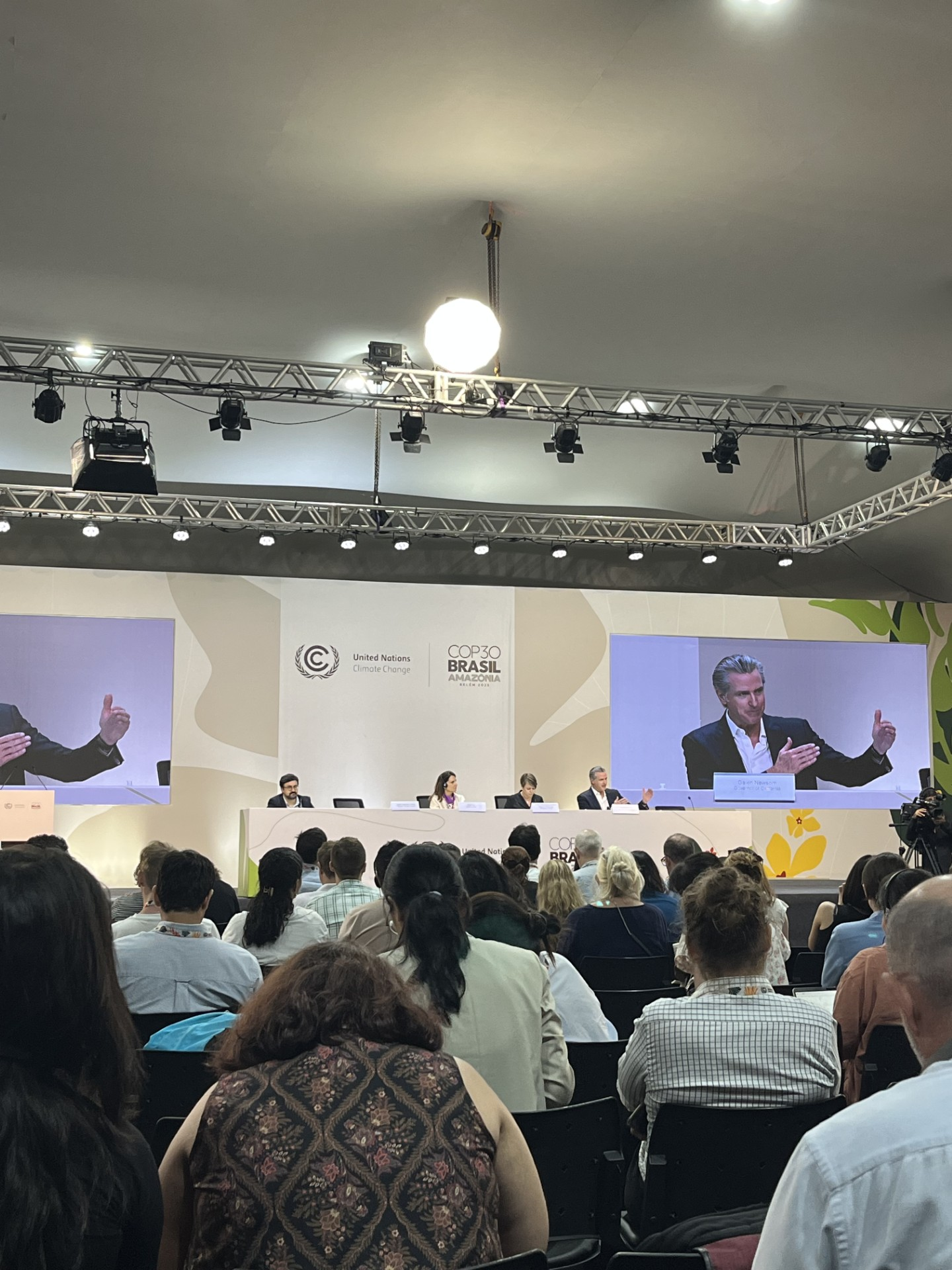
Josh Becker was part of a side event called “Setting the Stage for California Climate Action.” where he essentially spoke on behalf of the state and their progress in meeting the Paris Agreement 1.5 degree goal. He said that he wanted to offer a counter-narrative to the U.S. federal government in the low-carbon economic transition, and also that he came to COP30 to learn. He reported to the audience that the state is trying to promote renewable energy by proving cost reductions, and supporting programs like Cap and Trade to help transition their economy away from fossil fuels. With that said, Senator Becker also pointed out that 50% of Amazonian drilled oil goes to California as a way of emphasizing the impact a single state can have. I only made it into the end of Gavin Newsom’s panel with other subnational leaders like Malomö’s mayor Katrin Jemmeh, but I stuck around for questions he addressed after the panel. Newsom was also there to learn, but most importantly to send a clear message: California is all in. He spoke proudly that California government officials will continue to make strides in climate action and do what they can to become carbon neutral by 2035. He emphasized his despise for the Trump administration, and is concentrating on the power of his state’s government.
Other Subnational Contributions and Urban Approaches
The Loss and Damage Fund was created to aid the response of predominantly developing countries who are struggling the most with climate disasters though they have contributed the least to the total global emissions. This creates a situation where the wealthiest countries who have profited the most from their fossil fuel endeavors are responsible for providing the necessary funding for countries to not just adapt, but to pay for what they have already lost and will continue to lose. The fund is asking for about $400 billion dollars annually from developed countries, but the total pool from last year in 2024 for example, only reached $752 million. This occurrence is all too common to hear from developing country negotiators. The chair for the Least Developed Countries political bloc Evans Njewa from Malawi said in a panel discussion about his expectations for COP30 that, “Most of our adaptation will not be supported.” Even when financial assistance is received, it is not necessarily distributed to those who need it the most. Less than 1/10th of climate finance reaches urban, informal settlements where conditions are the hardest for coping with climate disasters and ongoing climate-related economic hardships.
Communities around the world are already adapting. As a speaker representing the International Institute for Environment and Development (IIED) stated from the panel titled “Building Deep Resilience and Life-Affirming Economies”, those facing the harshest consequences of climate change have come up with strategies and have valuable knowledge; the bigger issue is not listening to, and learning from, them. Later on in the week I interviewed an urban designer and architect named Dulari, who was representing an organization from Mumbai called Youth for Unity and Volunteer Action that mobilizes youth from the community to better understand and address their climate struggles and work towards creating solutions. I met her at a side event called “Cities and Community-led Responses: For a Climate Justice Agenda in the IPCC Special Report of Cities,” where I heard incredible stories about local actions being taken from being involved in urban planning to hosting their own “town hall COPs” to become more resilient. Dulari said that youth are often seen as “growth engines” rather than a group that can enact meaningful change. Youth are also often working informally and have overall heightened vulnerabilities to climate change.
She came to COP30 to help fill in the conversation gaps and involve those who are on the front lines of climate change, and to push for city agendas from developing countries like hers. Dulari felt that she unfortunately had the role of representing her local issues and reporting back on COP30, because the local leaders from Mumbai chose not to make the trip themselves. In response to my question about her hopes for outcomes from the negotiations, she responded that the biggest achievements she could already notice from week one was the “loud” presence of civil society, more so than in past COPs, and that the way civil society has been engaging is just as important an outcome as what may happen in the negotiations.
Links to Ecology and Agriculture
Urban areas are where most of humanity dwells and they are also where most GHG emissions occur. It’s evident that the materials and resources that supply our urban areas are usually from other places, which means that there are impacts from our supply and demand that we are not witnessing. All wealth comes from land and labor, and for many nations and neoliberal economic models it is beneficial for companies to conceal where their products are extracted/grown/created, along with who is doing the labor. Concealing these details hides who is suffering the consequences of their production, and an exploited group that is most ignored is non-humans. Humans have already lost value in today’s current economic system, which means that non-humans have an even deeper ignorance of their inherent value to live. Not only do non-species also demonstrate a will to live, but biodiversity is absolutely essential to sequestering carbon and maintaining Earth’s overall stability as a livable planet. Animals are ecosystem constructors and the driving force behind maintaining the abundance of live-giving materials and gifts that keep all humans alive. Climate change and habitat destruction threatens their ability to survive, and thus our own.
Lavenia Naivalu from Ocean First Voices and a district representative in Fiji shares in a panel discussion how much nature-based solutions are integrated in their country’s adaptation and phasing out of fossil fuels. Preserving wildlife preserves cultural identity, and is linked with eco-tourism which helps support local economies. Animals hold immense power in helping us mitigate the worst effects of climate change and cities might be the most important place to reestablish our multi-species relationships.
In a different panel about youth-led climate solutions for food, forest, and finance, public policy specialist Natalia Tsuyama said that a Just Transition means transition of power to youth, women, indigenous, and other marginalized communities. For example, indigenous activists from around the world advocate for more reciprocal relationships with biodiversity, and stress the importance of ecosystem health as inseparable from their own. Cities can be the center for these transitions of power, and demonstrate ways of living with a high importance of inclusivity, while promoting ecological sanctity and land stewardship. In Belém indigenous activists from the Amazon used the opportunity of COP30 to make their presence and climate-related suffering known, conducting protests and a march through the city, while also symbolizing a linkage between what we consume and where it is being sourced.

Agriculture is one of the biggest linkages to ways cities can have larger reductions in GHG emissions and improve climate resilience. Tricia Croadswell, the CEO of World Animal Protection, stated in a side event that food systems account for about a third of global GHG emissions, with industrial livestock at the center. The amount of land needed to feed these animals takes up 80% of our global agricultural land, even though animal-based foods only contribute to 17% of the global calorie supply and 38% of the global protein supply. This highly land-and-resource-intensive means of deriving food is not only highly inefficient, but also the leading contributor to deforestation and biodiversity loss. In our oceans, the industrial fishing industry has slashed marine biodiversity at rates faster than species can reproduce, using common methods like bottom trawling that capture other marine life and release massive amounts of carbon dioxide at the same time. The impact of agriculture and food systems on climate change is too profound to ignore, so what are people from COP30 doing about it?
In a side event called “Policy Tools for climate-aligned and Resilient Food Systems” I heard from a group of panelists about their approaches to the issues between food and climate. Rune-Cristoffer Dragsdahl, the Deputy Chair of the Danish Government Plant-Based Food Grant, has been working with farmers and politicians to incentivize a transition to plant-based proteins. His focus is on supporting farmers and building an infrastructure in the market where there is demand for plant-based foods. He reasons that the food system is implicated in almost all planetary boundaries, and that it is key in building even more bridges between them.
Another panelist, named Duda Salabert, the Federal Deputy of Minas Gerais, Brazil had a different approach in using the lack of food security, nutritional problems, and the impact of cattle on local indigenous groups as a way to promote plant-based foods through policy. He helps with solidarity kitchens in his city, and uses education about nutrition in schools to help teach more biocentric views about food systems. Ivan Euder, the Secretary of Sustainability Resilience, Well-being, and Animals Protection in Salvador, Brazil, goes to city hall meetings to also discuss food security and nutrition, offering pilot programs at schools to improve nutrition and reduce animal protein processed foods. They have expanded to about 400 schools and incentivize the teachers to bring students to learn about the land, grow food, connect with local farmers, and educate them about nutrition. The program has even led to significant reductions in their food-related emissions.
Each of these strategies to divert demand away from animal-agriculture are using aspects of urban living to find ways of avoiding the immense harm caused by our food system on species and ecological health. I find it so important that cities and subnationals incorporate food systems and diet changes as part of climate resilience, adaptation, and GHG mitigation. Cities play such an important role here in educating kids in schools about nutrition and food systems, and also by promoting plant-based foods and agriculture. Farmers will grow what there is a demand for so they know they can make profits, and these purchasing powers are of course the strongest in places where there are the most people; cities. I would also add that urban agroecology itself creates this linkage across species and between urban and rural areas, which can be an additional way for multi-species spatial relationships to be deepened.
Conclusion
Urban areas are key locations for the broader discussion of climate change involving GHG reduction plans, power as collaborators, places of extreme inequality and adaptation, and creating rural and multi-species linkages. I spoke with other attendees, and heard from a wide range of speakers about their perspectives on these topics of subnational urban ecologies, which gave me new insights in the wide range of strategies and methods for expanding the impact that cities and subnationals can have on a global scale. I am inspired by how much people are doing around the world, and how much consideration there is for not only disenfranchised human groups, but also for non-human animals who do not have a voice at the COP. Duda said something I thought was very powerful, which is “How we treat animals affects our economy,” and I see this as applicable to not just animals but ecosystems in general. Urban spaces have a lot of work to do on building those relationships, and I hope recognizing our power as individuals within subnationals can help us reimagine our impact we have. COP30 really is about making the global local, and the local global.
Bibliography
“California extends cap-and-trade to 2045, renames program ‘Cap-and-invest.”’ (2025.) International Carbon Action Partnership. https://icapcarbonaction.com/en/news/california-extends-cap-and-trade-2045-renames-program-cap-and-invest
“California is now the 4th largest economy in the world. Governor of California”. (2025, April 24). Governor Gavin Newsom. https://www.gov.ca.gov/2025/04/23/california-is-now-the-4th-largest-economy-in-the-world/
“Cities have a key role to play in tackling climate change- here’s why.” (2019). United Nations Development Program. https://climatepromise.undp.org/news-and-stories/cities-have-key-role-play-tackling-climate-change-heres-why#:~:text=Due%20to%20this%20population%20density,leaders%2C%20planners%20and%20technical%20experts.
“COP30 local leaders forum” (2025, November 19). Bloomberg Philanthropies.
Hannah Ritchie and Max Roser (2019) – “Half of the world’s habitable land is used for agriculture”. Published online at OurWorldinData.org. ‘https://archive.ourworldindata.org/20251125-173858/global-land-for-agriculture.html’
Hannah Ritchie, Veronika Samborska, and Max Roser (2024) – “Urbanization” Published online at OurWorldinData.org. Retrieved from: ‘https://ourworldindata.org/urbanization’
Hiddink, J.G., van de Velde, S.J., McConnaughey, R.A. et al. (2023). “Quantifying the carbon benefits of ending bottom trawling.” Nature 617, E1–E2 https://doi.org/10.1038/s41586-023-06014-7
“IIED is an independent research organisation that delivers positive change on a global scale.” (n.d.) International Institute for Environment and Development. https://www.iied.org/
Lai, Olivia. (2021). “5 Biggest Causes of Biodiversity Loss”. Earth.Org.
“Local Governments for Sustainability”. (2025, December 2) ICLEI.. https://iclei.org/
Markandya, A., González-Eguino, M. (2019). “Integrated Assessment for Identifying Climate Finance Needs for Loss and Damage: A Critical Review.” In: Mechler, R., Bouwer, L., Schinko, T., Surminski, S., Linnerooth-Bayer, J. (eds) Loss and Damage from Climate Change. Climate Risk Management, Policy and Governance. Springer, Cham. https://doi.org/10.1007/978-3-319-72026-5_14
Sheldon, Marissa. (2022). “Salvador, Brazil to Serve 10 million Plant-Based School Meals Per Year.” Hunter College New York City Food Policy Center. https://www.nycfoodpolicy.org/food-policy-snapshot-salvador-brazil-plant-based-school-meals/
Woods, D., & Ma, A. (2022, September 9). The impact of California’s environmental regulations ripples across the U.S. NPR. https://www.npr.org/2022/09/09/1121952184/the-impact-of-californias-environmental-regulations-ripples-across-the-u-s#:~:text=California%20is%20known%20for%20having%20some%20of,buildings%20more%20energy%2Defficient%20*%20Car%20emissions%20regulation
Highlighting how urban planning, transportation, housing, and infrastructure all intersect with climate resilience helps make the crisis feel real and actionable. It reminds us that solutions aren’t just about abstract emissions targets — they require thoughtful, equitable policy, community engagement, and investment in sustainable systems that improve quality of life for all residents.