 Library unknown. Thanks, George Takei!
no Nazgul in the library, please
Leave a reply
Library unknown. Thanks, George Takei!
 Emily Lloyd’s Shelf Check blog comic is a constant source of excellent library shenanigans. Her latest: “sneak previews” of a fill-in-the-blanks game called Cards Against Librarianship. Is the game imaginary? I don’t know. Probably. But she had me at LeVar Burton being stuffed into the book drop, and now I have the Reading Rainbow theme song stuck in my head. (Have you heard Jimmy Fallon’s Doors version?) Here are the Cards Against Librarianship previews one, two, and three.
UPDATE January 21, 2014: the game is real, and you can download your decks here. I want to play!
“The Carol of Final Exams” from the University of Maryland library. Sometimes it’s okay to cry in public. Thanks, CC library Facebook page!

This drawing appeared anonymously in December 2013 on the whiteboard at Portland State University Library. Is this proof that the digital world is not going to replace the analog world, but rather exist alongside, intertwined? I think yes.
Thanks, Joan Petit!
If I’d been in charge of this oddly beautiful shenanigan, I would have started at 2:02 and then circled around to the beginning after we see the drone. Thanks, Dina Wood!
 During a recent book move in Special Collections, we discovered, by chance, some wonderful surprises in our rare book vault. For example, it turns out we have a full Rump … a nineteenth century facsimile of a two volume set first published in 1662, officially titled Rump: or An Exact Collection of the Choycest Poems and Songs Relating to the Late Times. The books contain political poems and songs and, well, as you can guess, a lot of butt jokes. Mark McDayter at the University of Ontario has a rather thorough website about Rump, and a digital version of the facsimile is available at the Internet Archives. (I learned from McDayter that you can tell the difference between the 1662 first edition and the 19th century quasi-facsimile by looking at the S’s. The original edition uses the long ∫ throughout; the quasi-facsimile never uses it.)
 We also learned that we have Rats, or rather, Histoire des Rats by Claude-Guillaume Bourdon de Sigrais, published 1737, containing this gorgeously creepy engraving (detail). A digital facsimile of Rats is available from Google Books A digital facsimile of Rats is available from Google Books.
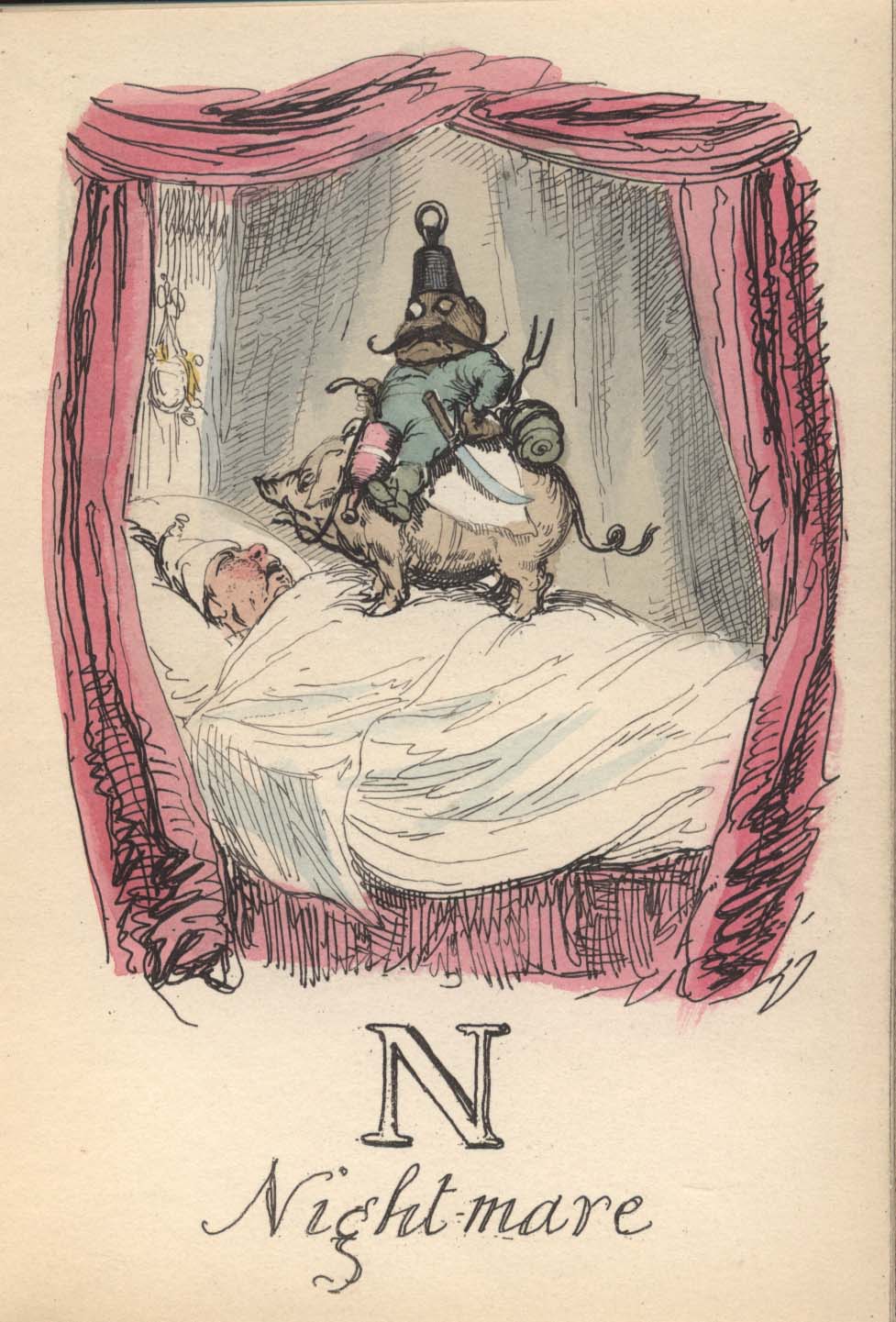 And if that illustration wasn’t enough to give you a nightmare, here’s a different kind of nightmare for you, from another recent discovery, George Cruikshank’s Comic Alphabet (1837). (We have many other alphabet books, including a popular pop-up.) A full version of the Cruikshank is available digitally here.
 BoingBoing’s no-text post with this image, posted November 12, 2013, is titled “Fragmentary evidence of the lost ancient art of librarian miniaturization,” which counts as a shenanigan, I think.
The image is all over the internet, sometimes with a citation to the Archives of Prague Castle. [UPDATE, November 14: I’ve just received an email from Martin Halata, head archivist at Prague Castle, who tells me the photograph is not from their archives.] It’s even got lolz versions in Czech [I found these a few days ago but now I can’t find them anymore and it’s driving me crazy].
I used Google’s nifty image search mechanism to discover that — as far as I can tell — this image first appeared on the internet on April 22, 2013, at Lost and Found in Prague. The photographer is M. Peterka and the date is unknown. [Some versions of the image appear with a date of ca. 1940; some say the person in the picture is a man; others say it is a woman.]
MAJOR UPDATE, January 2023: Piotr Kowalczyk of “Reader Updated” has found the original source of this image. It appeared on page 35 Fotorok, volume 58, Issue 1, 1959, with the caption (in Czech): “Archivy chystají velkou jarní výstavu československé státní myšlenky na Pražském hradě,” translated by Kowalczyk as “The archives are preparing a large spring exhibition of the Czechoslovak state idea at Prague Castle.” The photographer was Miroslav Peterka, and the location was the Clementinum in Prague.
 The Paris Review gives us this incredible view of the enormous slide used to move books from one building to another at Columbia University in 1934. (A similar slide was used at Colorado College in the great book move of 1962.) Click the image to see other, less enormous, more fun library slides. Thanks, Brooklyn Blowback!
 Circulation staff at Colorado College’s Tutt Library have found a couple of decorated hard-boiled eggs on bookshelves in our stacks. We’re not sure who’s behind this, or how long it’s been going on, and you know we’re all for library shenanigans in general, but this one has some potentially yucky consequences down the line. We humbly request: if you want to hide eggs in the library, could you maybe use plastic eggs, or blown eggs, or, you know, any kind of non-smelly, non-messy egg-like items instead?
Thanks, Marianne Aldrich, for the photo.
 As Ryan Broderick of Buzzfeed puts it: “Oh My God, There’s A Cat In Russia That Wears A Bow Tie And Works As A Librarian. The world is a beautiful place.”
Thanks, Kathleen Kirk (and others, but Kathleen was first).