Is your dance card full?

Dc constant Dc crandall

We have dozens of 19th and 20th century dance cards in the Colorado College archives. (The examples above, both from 1912, belonged to CC alumnae Dorliska Crandall and Katherine Constant.) Students find the cards intriguing, and ask lots of questions about them: how did this dance card thing work, exactly? Did you fill out your dance card in advance of the dance, or at the dance, or afterward as a souvenir? Almost all our dance cards are from women’s scrapbooks. How did men keep track of their dance partners? Did they just keep the list in their heads?

V. Persis Dewey’s 1918 pamphlet “Tips to Dancers: Good Manners for Ballroom and Dance Hall” holds the answers. Dewey tells us, in no uncertain terms, the proper use of dance cards:

The programs are distributed at the door, in the cloak room, or during a grand march. It is the duty of the man to make out the programs for the lady whom he has escorted to the dance and for himself. It is best to make out the programs all at once and as early in the evening as possible.

In filling out a program, the man should write his name on the first line of his lady’s program, and her name on his. To indicate their dances, a double cross xx should be used.

At a program dance where the men and women come separately, each one keeps his or her own program. When the man invites a lady to dance he writes his name on her program after the number they decide to dance together.

These conventions, breakable as they must have been, suggest that our dearth of men’s dance cards comes less from men not using them and more from men not saving them in scrapbooks. And indeed, with a bit of sleuthing, I did find several dance cards belonging to Eugene Gordon Minter, CC class of 1930. Some of these cards have erasures and corrections, suggesting that Minter’s original dancing plans might not always have come to fruition.

Dcfront Dcinterior Dcwitherasures Dcgeorge

Both women’s and men’s dance cards include both women’s and men’s names. Mr. Dewey does not speak of same-sex partners in his pamphlet on dance etiquette, but it seems that same-sex partners were a normal and natural part of formal dances in the dance card era.

I think I would have really dug this whole dance card thing in high school and college, but maybe not so much in middle school, when it seems likely my dance card would have been filled with names like “I.P. Freely,” “Seymour Butts,” and “Mr. Bates.”

Sources: Dorliska Crandall scrapbook, CC Archives box 947; Katherine Constant collection, box 545; Eugene Gordon Minter scrapbook, box 923.

Sand Creek Massacre memoir: “all one sided”

Isaac Clarke memoir

Isaac Clarke memoir

page 191

page 191

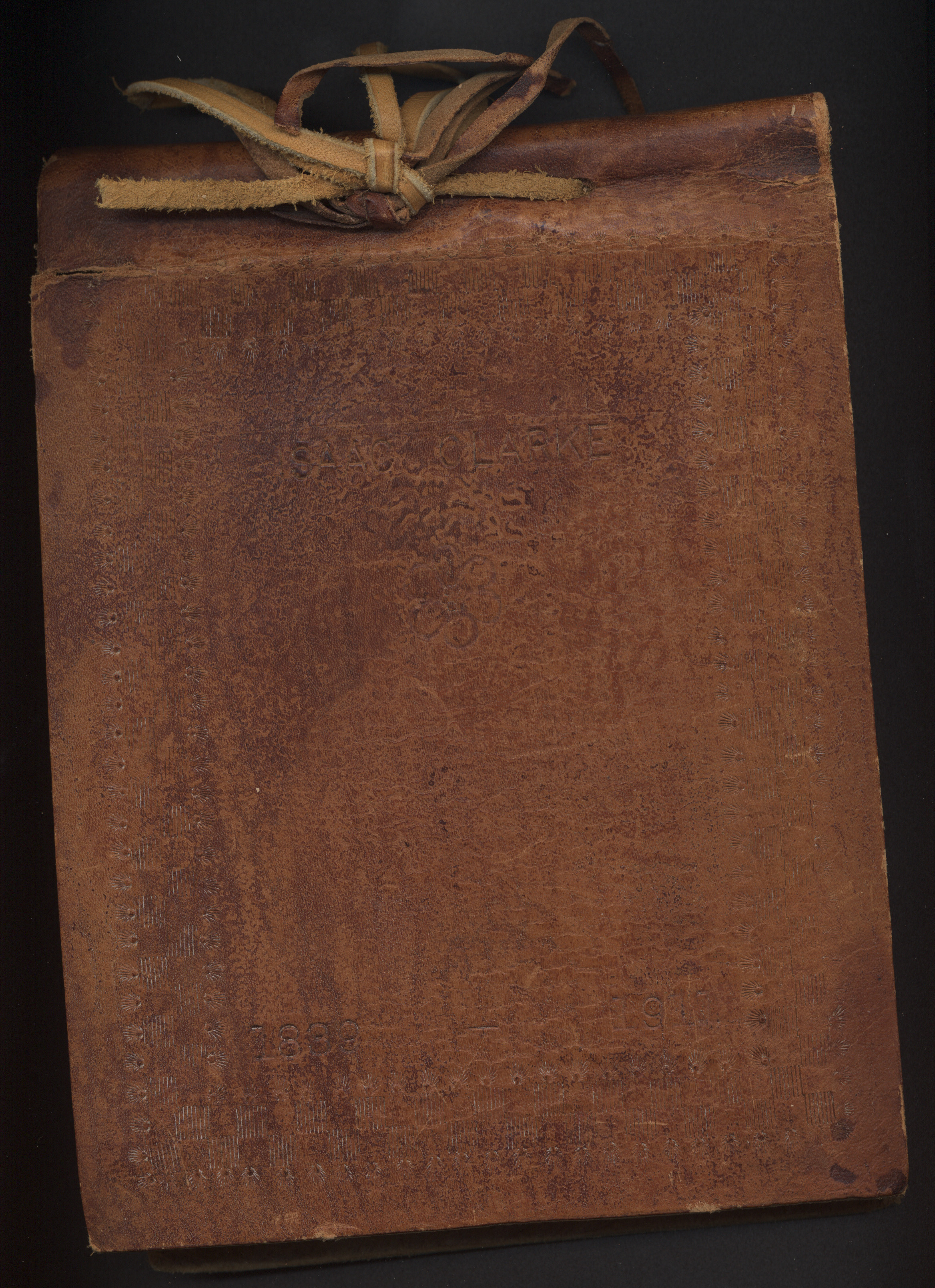
In September of 2013, we received an amazing gift from Tom Courtney: a 200-page leather-bound handwritten memoir, dated 1892, by Isaac Clarke, a Union soldier who witnessed the Sand Creek Massacre in 1864.

Along with the manuscript, we received a 60-page typed “reconstruction” of the memoir, available in full here. See pages 40-43 of the reconstruction (179-195 of the original) for Clarke’s memories of Sand Creek.

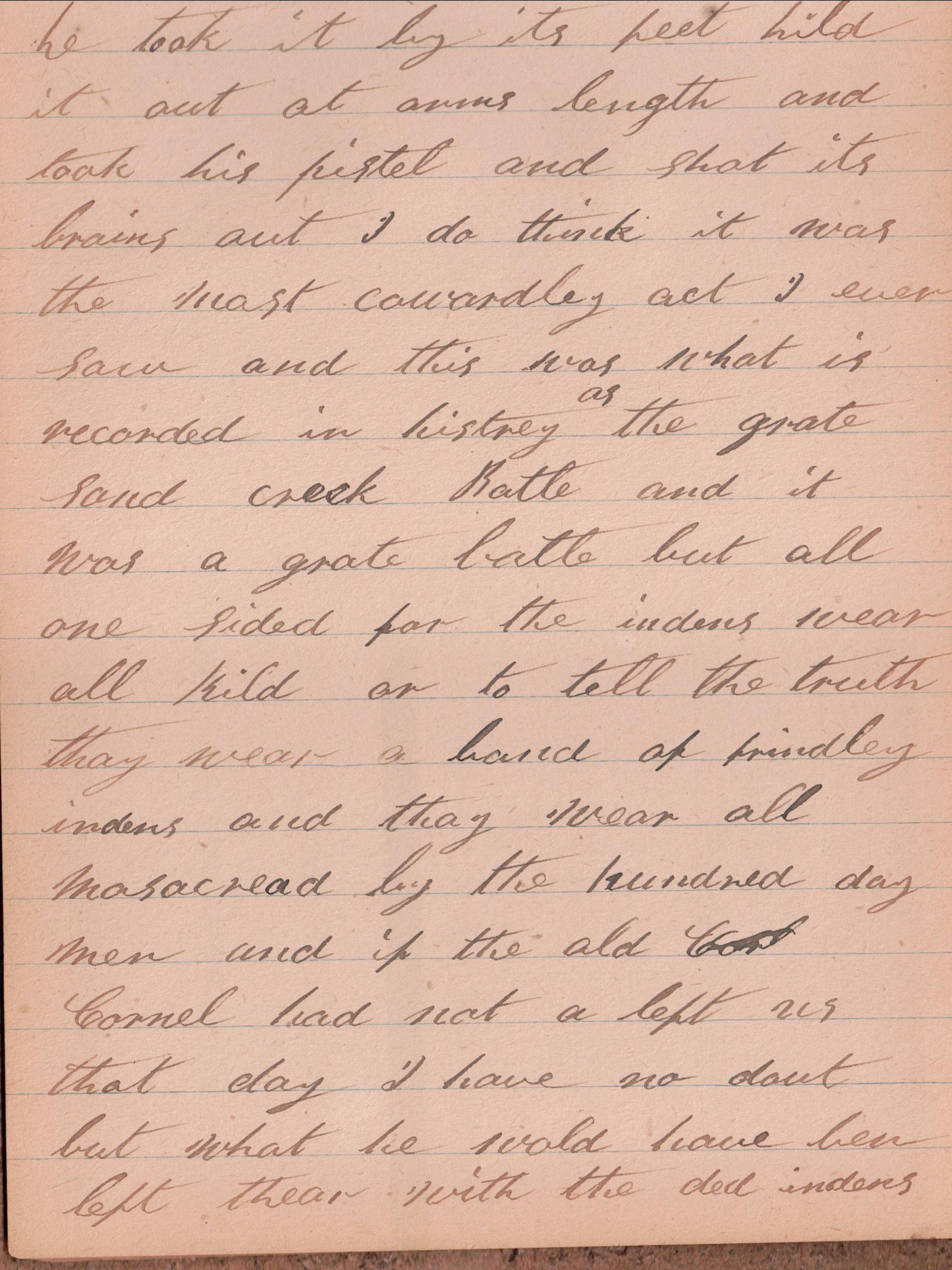
Please note: the reconstruction corrects spelling and syntax and frequently paraphrases Clarke’s words, sometimes changing the meaning or emphasis. For example, on page 191 of the original (pictured above), Clarke writes:

“…I do think it was the most cowardly act I ever saw and this was what is recorded in history as the grate sand creek Battle and it was a grate battle but all one sided for the indens were all kild an to tell the truth they wear a band of friendley indens and they were all masacread by the hundred day men.”

The reconstruction for this passage reads:

“…It was the most dastardly, cowardly act I ever saw, and this was what is recorded in history as the Great Sand Creek Battle. The truth of the matter was that it was a band of friendly Indians massacred by a regiment of white savages, the hundred day men.”

If possible, therefore, researchers should visit CC Special Collections and consult the original rather than depend solely upon the reconstruction.

cake in the library?!

cake-1The Huntington Library in San Marino, CA has decided to attempt to preserve two pieces of wedding cake found in the papers of Edwin Carpenter. The pieces date from 1876 and 1915 and have “little research value.” Nevertheless, the staff have found themselves reluctant to discard cake. (I’m with ya, Huntington Library.) Thanks, Steve Fisher!

1487 demonology book

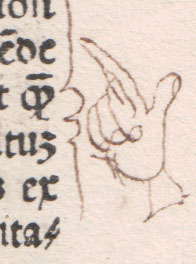
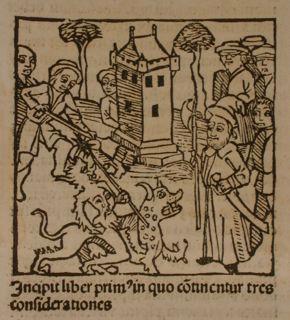
fortalitium marginaliapointyphingerCC Special Collections recently purchased a 1487 edition of Alphonso de Spina’s Fortalitium Fidei (Fortress of Faith), written in 1458 and published anonymously multiple times in the late 15th century. The Fortalitium is a pro-Catholic work containing arguments against Muslims, Jews, and other detractors; its final section is on demons and how to fight them. It may be the first printed book to discuss witchcraft, and most certainly played a part in the Spanish Inquisition. The Fortalitium is generally understood to be an anti-Semitic work; some believe that de Spina, a Franciscan priest, converted from Judaism.

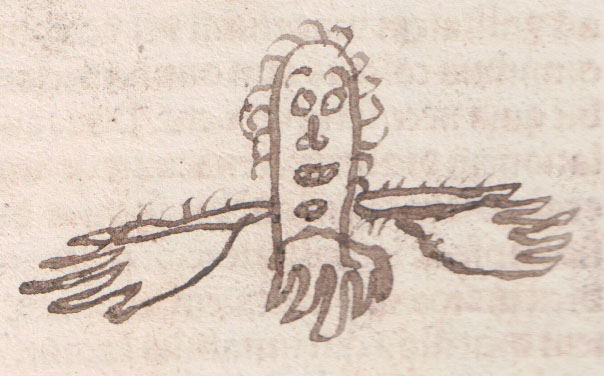
chestfaceOur edition (Lyon: Guillaume Balsarin) is in a later binding (probably 19th century) and contains a single woodblock illustration  depicting a demon with horns on its head and a face in its chest, perhaps a cousin to the Blemmyes (Latin Blemmyae), who have faces in their chests and no heads at all. Our copy, formerly in the library of the Convent of St. Francis of Siguenza in Guadalajara, Spain, has unusual marginalia from a former owner or owners, including decorative marks and, on the final page, a sort of doodle of a fuzzy-haired, winged demon.

doodle

stallybrass


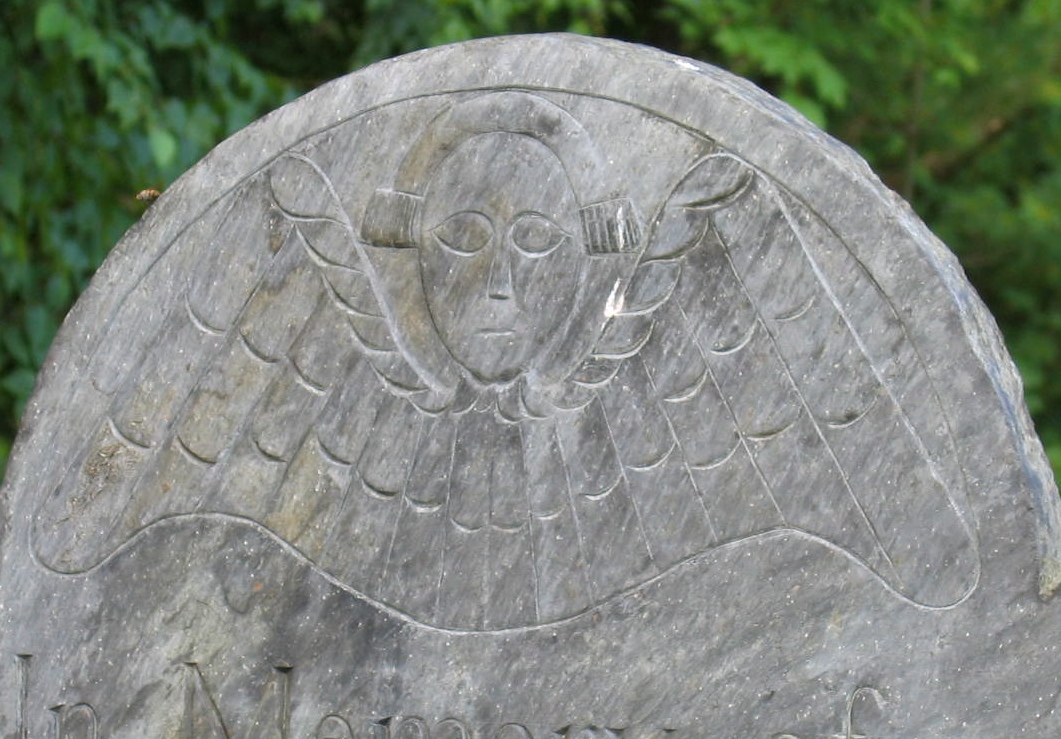
ADDENDUM: in September of 2013, Penn’s Peter Stallybrass  visited Special Collections and viewed our copy of the Fortalitum. He believes the doodle may depict an 18th-century gravestone similar to those in the photographs below. We concur!


medusa 1797 Sweetsers-medusa  1776 Lydia Bordwell