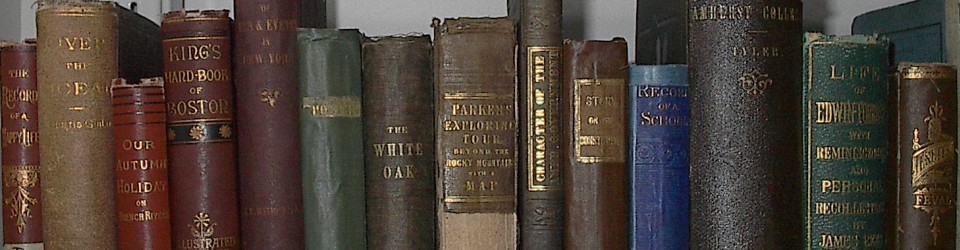
 According to Jill Lepore’s excellent book The Mansion of Happiness: The History of Life and Death (2012), 19th century New York public libraries had different rules for girls and boys. To use the Astor Library, for example, you had to be fourteen years old … and male. Do you know what this means, shenanigan connoisseurs? This means that any girl who used the Astor Library was committing a shenanigan! I am working on finding out more about this cockamamie rule, but I had to tell you right away about all the presumable shenanigans that must have taken place in the late 19th century in New York. Girls with fake mustaches? Girls in drag? Presumably girls and women were, at some age, allowed in the Astor, but I don’t yet know the exact age requirement for them. I’m working on it; check back in a week. Now, in the 21st century, the NYPL rules state that all children from the age of zero upward are eligible for library cards. I like the idea of a newborn baby having a library card.
Thanks, Jill Lepore, and, by way of Lepore’s footnotes, thank you also to Miriam Braverman and her book Youth, Society, and the Public Library (1979).
Addendum, August 13: Braverman’s book doesn’t discuss the Astor Library. The factoid about boys fourteen and up appears in another source Lepore cites, Frances Clarke Sayers’s Anne Carroll Moore: A Biography (1972). Beginning in 1896, Moore was a children’s librarian in New York City; for better or for worse, she had long-lasting national influence on the profession. Unfortunately, Sayers’s biography doesn’t contain any added information about the age requirements for boys and girls at NYC libraries. I would like to think the Astor Library allowed all girls in, regardless of age, though that’s not what Sayers implies. The librarian of the Astor in 1854, when the rule about boys fourteen and up was in place, was not impressed with the books the “young fry” chose to read; he described their choices (Scott, Cooper, Dickens, Punch, and the Illustrated News) as “trashy” (Sayers, p. 106). Circa 1868, both girls and boys under the age of sixteen in Washington Heights could pay five cents a week to use the library there (Sayers, p. 110). As far as I can tell, boys and girls had equal access to children’s libraries in NYC in Moore’s time. I’ll keep working on it.