Category Archives: shenanigans

ISBN shenanigan

onbeyondzebraAs Curator of Colorado College Special Collections, I recently ordered a copy of Woody Leslie’s book Understanding Molecular Typography. There appeared to be a snag in the cataloging, and the following email conversation ensued:

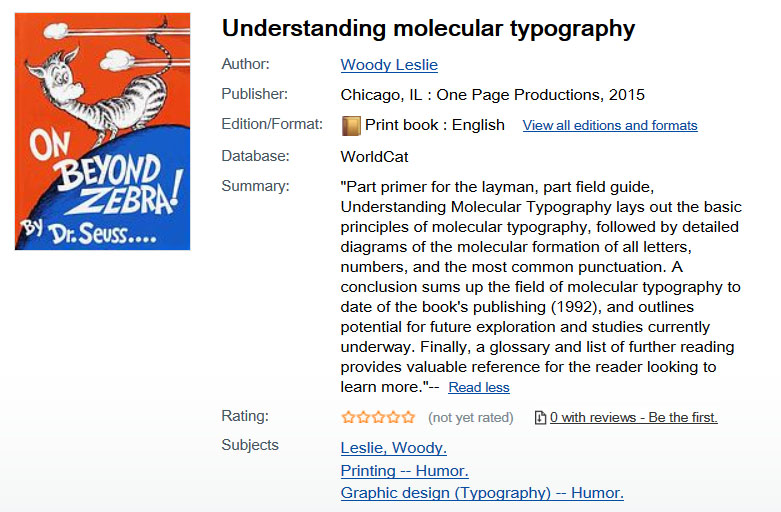
Cataloger Amy: Hello, Jon (and Jessy),  If this link is behaving as it was for me just now, then you will see the image, with a link, to a Dr. Seuss book to the right of the title I just cataloged, “Understanding Molecular Typography.” Hmmmmmmm……..  :-/

Systems Specialist Jon: That bib record contains the ISBN for the Dr. Seuss title so it’s pulling the Dr. Seuss book cover image… Correcting or removing that ISBN should fix the problem. I also noticed that a subject heading of Humor is shown on that bib-is that correct?

Amy: I figured it had to do with the ISBN. The ISBN in the record is indeed the ISBN on the title page, so, I’m not sure how one might handle that. About humor, yes, that is correct, despite the rawther serious-sounding title.

Jon: Interesting-so it’s a humor book and they put the ISBN for a Dr. Seuss book on the title page? That’s kinda funny. WorldCat seems to have the same problem: http://www.worldcat.org/title/understanding-molecular-typography/oclc/920580763 –as do the catalogs of all of the other libraries WorldCat shows as holding this title… This is now actually hilarious.

Curator Jessy: Wow. This is fantastic actually! I wonder if they did it on purpose. Maybe I’ll try to contact the author or publisher and see.

Amy: I’d love to know what he says. It’s kind of like a library shenanigan. I mean, why “On Beyond Zebra”?? This is a first, for me.

Jessy: Dear Woody Leslie, As you can see from the email chain, your book is causing some confusion and hilarity at the Colorado College library. We think you did it on purpose. Are we right?

Artist Woody Leslie: Hi Jessy, This really made my day! Thanks for contacting me. Yes, I intentionally appropriated that ISBN number. Understanding Molecular Typography is a fictional textbook by a fictional author about a fictional science — the science of molecular typography, which is based on the premise that all letters are in fact molecules, composed of atomic shape units known as typtoms. One of the ideas of the book is the concept of genetically modified, or invented letters. I used that ISBN number as a tribute to Dr. Seuss’ book On Beyond Zebra, because it’s all about invented letters. I didn’t account for library cataloging of ISBNs when I used it, figuring it would mostly be ignored. I too have noticed the World Cat auto picture selecting based on the ISBN. Glad you were able to sort it all out. There’s more about the book and project here.

John Latham’s “Art and Culture”

latham
My colleague Diane Westerfield found a library shenanigan in a scholarly article!

“The Library in Art’s Crosshairs” by Henry Pisciotta. Art Documentation: Journal of the Art Libraries Society of North America, v. 35 no. 1, Spring 2016.
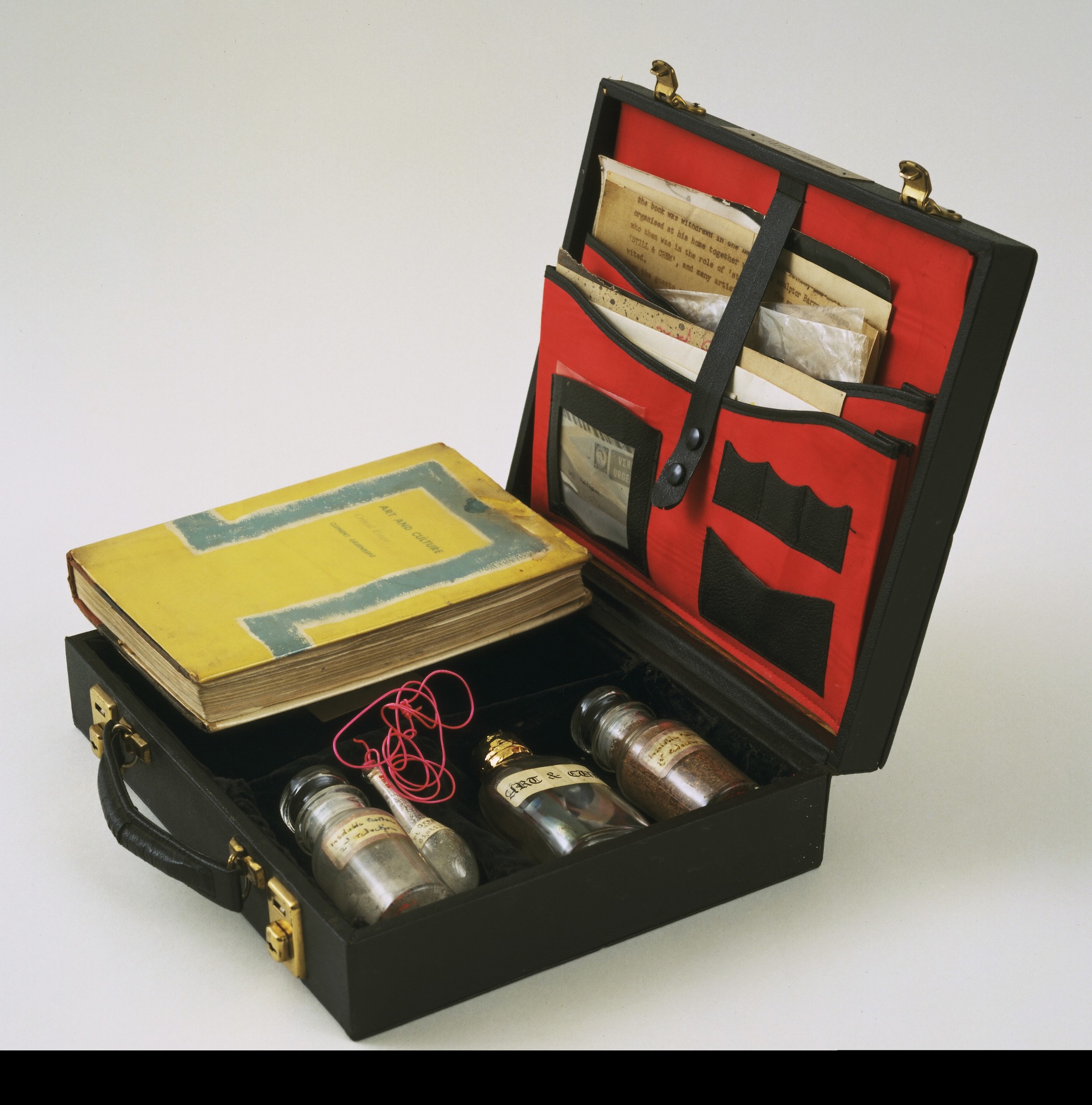
“British artist John Latham, while teaching at St. Martin’s School of Art in 1966, checked out a copy of Greenberg’s respected book [Art and Culture] from his school’s library and took it to an evening gathering of friends and students, where the book’s pages were removed and chewed, by a number of participants, and spat into a jar. Later Latham, keenly interested in science, performed a series of chemical transformations on the remains, slowly reducing them to a goo, which he sealed into a glass vial. Overdue notices were received from the library, so Latham eventually attempted to return the book to the librarian in its modified state. This offer was refused. Latham’s teaching contract was not renewed. A few years later, Latham fashioned a carrying case for the vial, some of the lab apparatus, and the library notices, and  today the assemblage is in the collection of the Museum of Modern Art.”

The resulting artwork, titled, like the original book, “Art and Culture,” is not currently on view at MoMA, but you can see more information about it here.

art made from digitized non-circulating books

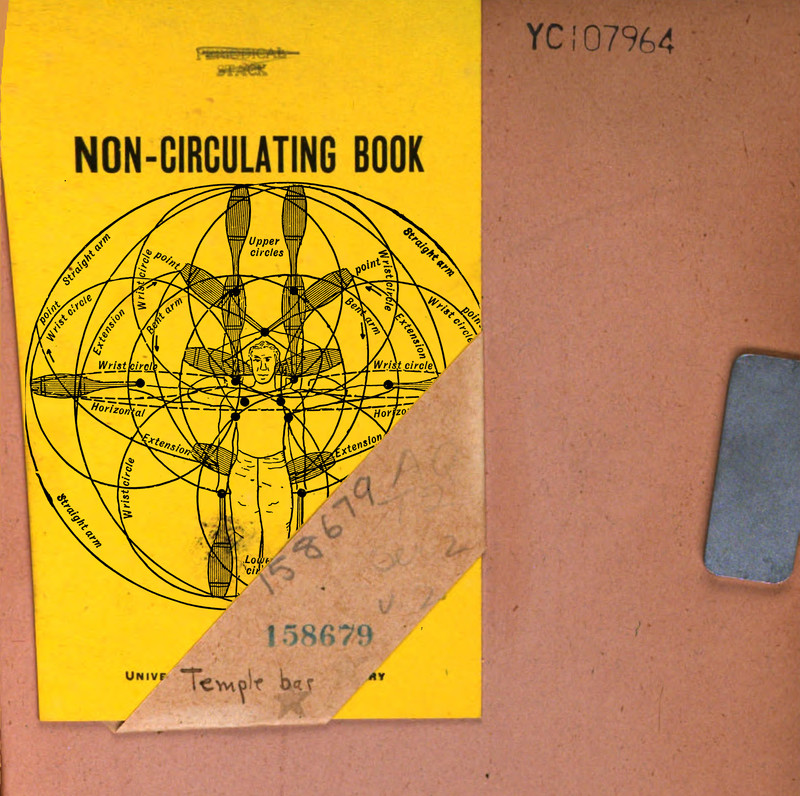
Temple BarCraig Conley makes visual art from digitized “non-circulating” library books. As he explains in his artist’s statement:

Some library books, for a variety of reasons, become “non-circulating.”  … It’s a precious status, indicative of value, rarity, and refererence-worthiness.  Yet there’s a tinge of sadness, too — a hint of decrepitude and dormancy.  We asked a book-whisperer and learned that books do wish to circulate, to be worldly, to mingle, to be at large. …  Then, through a painstaking process involving collaged elements from non-circulating volumes of old magazines, we add some talisman-like flowing imagery to break the stagnation …

I’ve got a golden ticket…

…I’ve got a golden twinkle in my eye…

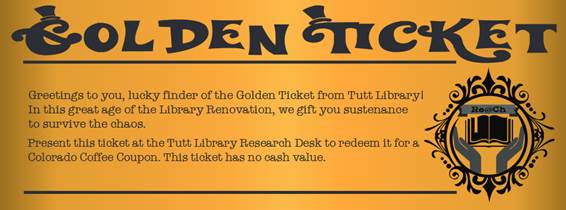
Colorado College’s Tutt Library is currently undergoing a major renovation, and most of our books are off-site until the fall of 2017. During this school year, as we retrieve and drop off materials multiple times a day, we are placing golden tickets into random books:

goldenticket

And thus, I have this song in my head almost all the time now.

blueberry shenanigans

Guest blogger Jonathan Caws-Elwitt supplies these excellent Susquehanna County Library Shenanigans.
Newberry

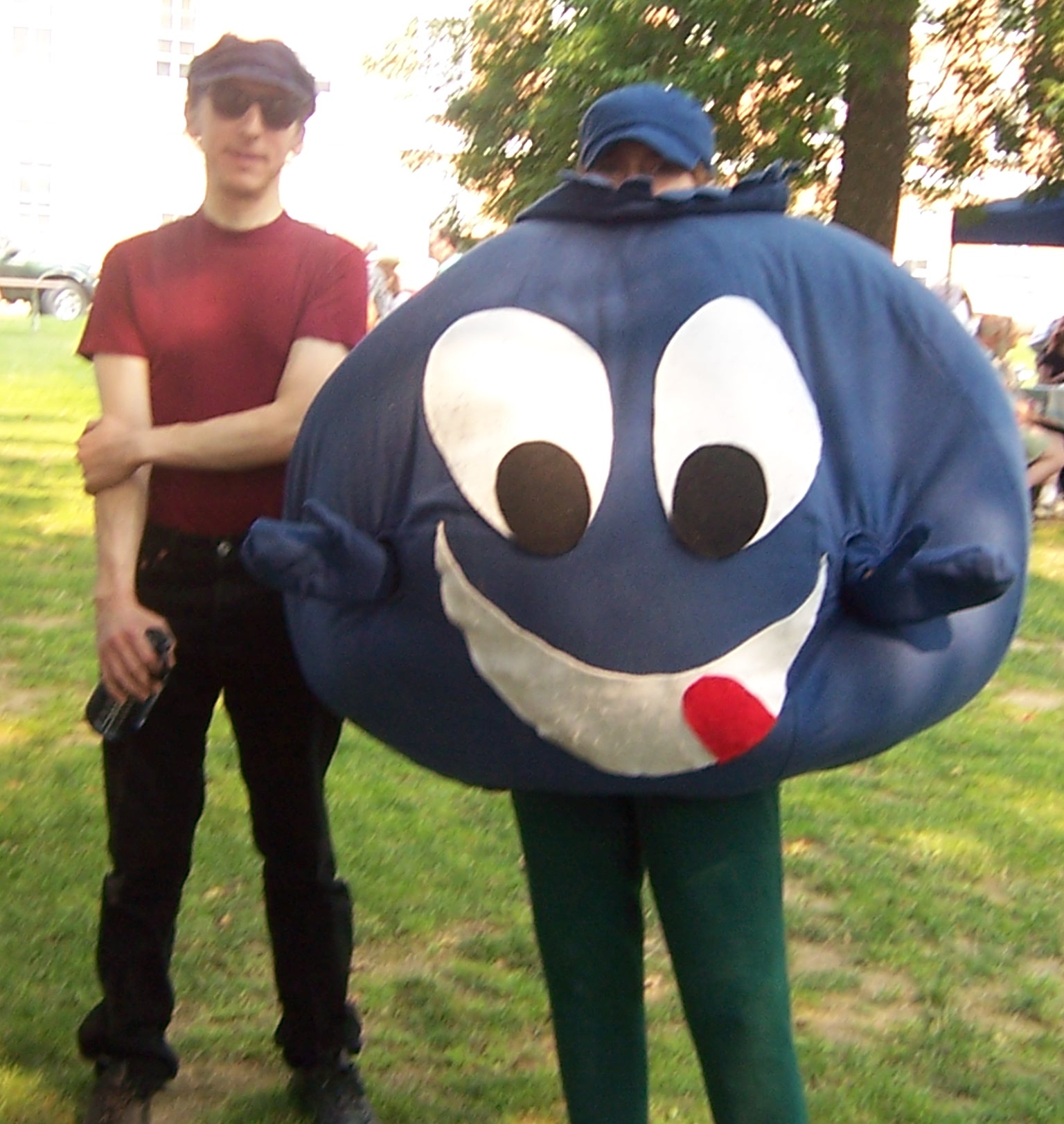
Newberry the Blueberry [at right] with the author, 2007.

When my wife, Hilary Caws-Elwitt, worked for the Susquehanna County library system in Montrose, Pennsylvania, an important part of her job—an important part of everybody’s job—was the Blueberry Festival, the big annual fundraiser held every August.

Most years, Hilary’s festival duties included some time spent working the crowd in the Newberry the Blueberry costume. That was normal. But in 2006, Hilary added to her repertoire by staging another little stunt for herself.

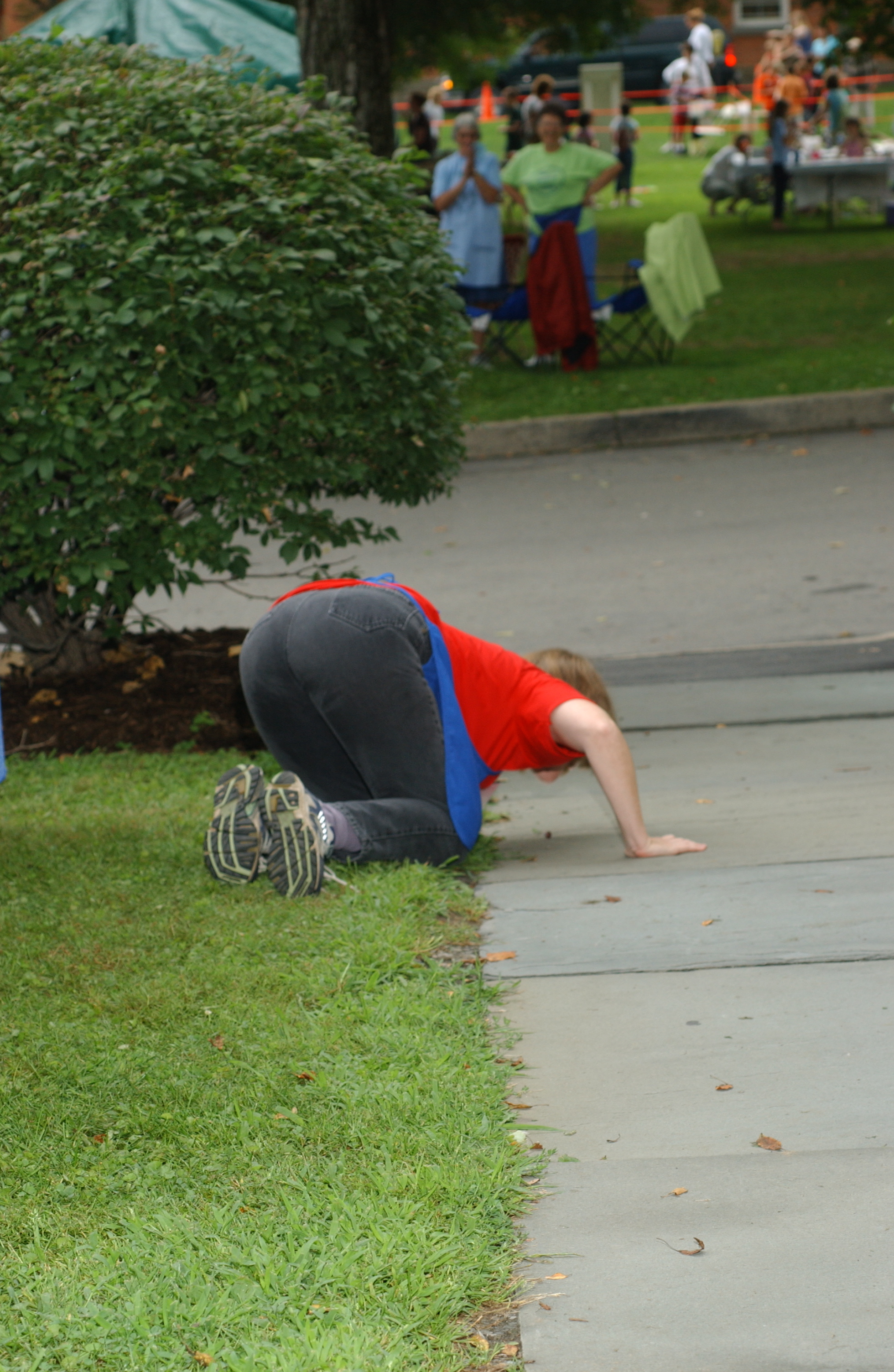
The library had been selling Blueberry Festival cookbooks, and Hilary wanted to try offering them online. As she explains, “because the time spent would be a gamble, I ‘bet’ my boss that I would roll a blueberry down the sidewalk with my nose if we didn’t sell at least N copies (or make X dollars—I don’t remember which it was).” She notes that the bet was a premeditated idea, not an impulse of the moment.

And though Hilary did her best to market the cookbooks, she admitted at the outset that she was “rooting to lose, because I thought it would be funny and possibly newsworthy” to do the blueberry-rolling stunt.
blueberry_nose

Hilary Caws-Elwitt rolls a blueberry down the sidewalk.

Hilary continues: “We didn’t quite meet the target by the time July rolled around, so in my pitch letter to the local TV news stations [for festival coverage], I mentioned that I’d be doing the stunt. At the designated time, a TV crew was indeed present.” But, in terms of spectacle value, the display did not quite bear fruit. “Rolling the berry, even downhill, was quite challenging because it was so small, blueberries aren’t very round, and the sidewalk was rough.” The halting and inelegant progress of Hilary and the berry down the sidewalk didn’t shape up as what we’d call “good television.”

However, the stunt did make it onto television … and yet there was a little issue with contextualization. “The footage ended up being broadcast under a narration about the festival, which didn’t mention at all who I was or what I was doing. So there was no explanation for why this middle-aged woman was crawling around on all fours with her butt in the air.” The blueberry, of course, was too small to be seen by TV viewers. “Luckily I never mind making a fool of myself.”

by Jonathan Caws-Elwitt