Leaf from a Chinese woodblock book

In March of 2012, Special Collections acquired a single leaf from a 19th century Chinese woodblock printed book. This leaf, mounted on heavy paper, is a bifolium (two-page spread) from the Zizhi Tongjian (Comprehensive Mirror for Aid in Government), and was probably printed in the 19th century. The first edition of the text was produced in the 11th century using the same kind of printing technology.

We will use this leaf in conjunction with our other manuscript and printed leaves when we talk about the history of the material form of the written word in support of CC’s thematic minor in book studies.

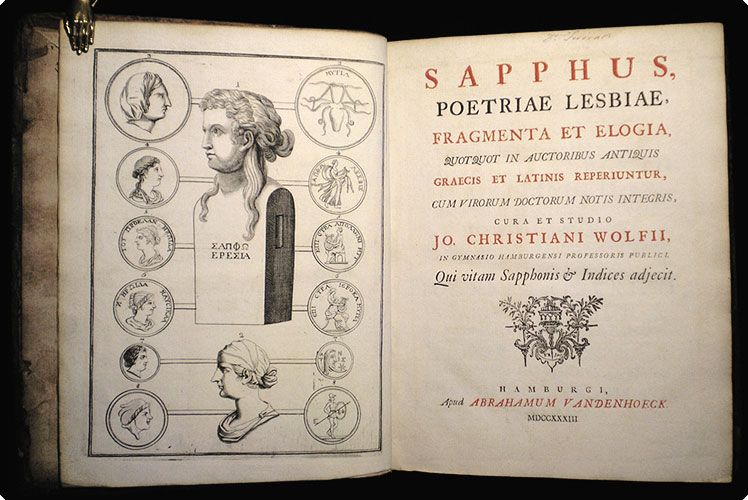
First solo Sappho!

 
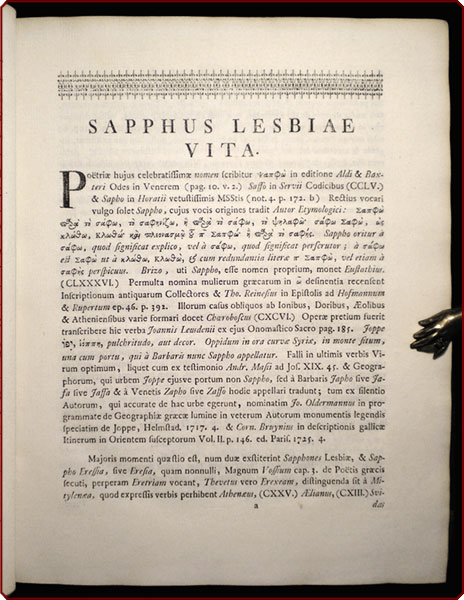
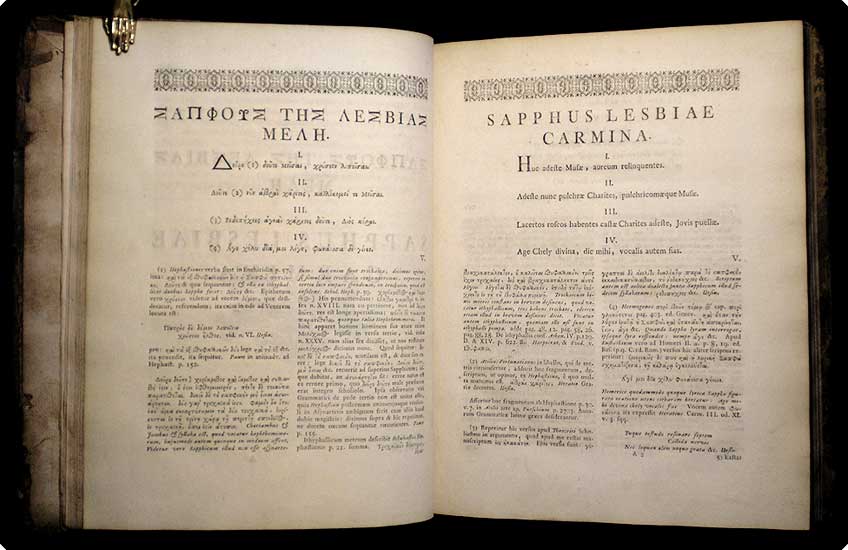
Another book acquired in February 2012 through a gift from our anonymous donor: the first solo printing of Sappho’s poems. Up until Abraham Vandenhoeck printed this book in Hamburg in 1733, Sappho’s poetry had appeared only in multi-author collections like this one from 1600. 1733 may seem awfully late for a solo Sappho, but not when you remember — as CC Classics Professor Owen Cramer reminded us — that the majority of her known work wasn’t discovered until the late 19th century.

Our new book has Greek and Latin on opposite pages and an elaborate frontispiece with a bust of Sappho surrounded by ancient coins. We don’t know how the editor, Johann Christian Wolf, was able to compose a 32-page biography of Sappho (born ca. 615 B.C.), but we commend his effort.

With the ownership signature of Michael Wodhull (1740-1816), poet and translator of Euripides. Colorado College students, faculty, and staff have access to much of Wodhull’s work in paper at Tutt Library or via Eighteenth Century Collections Online.

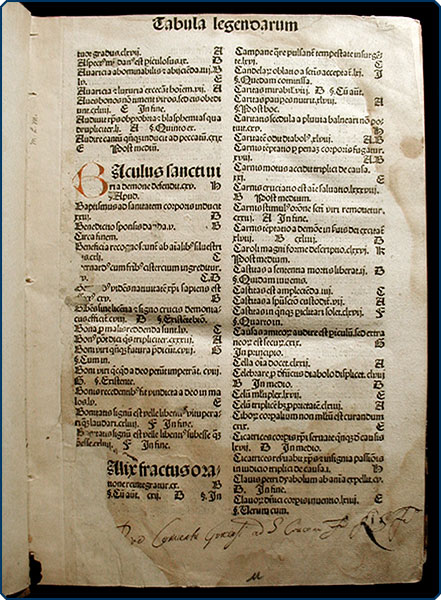
CC Special Collections acquires its fourth incunable!

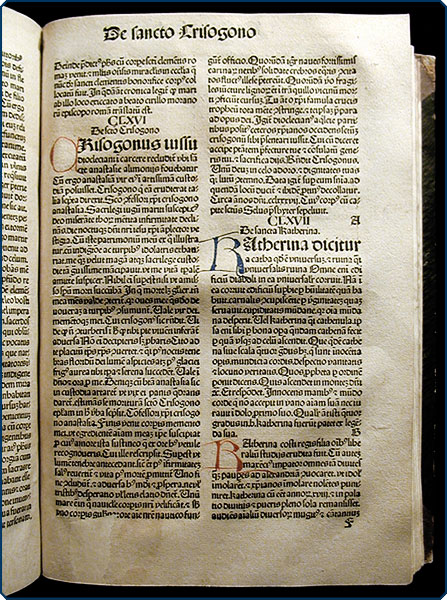
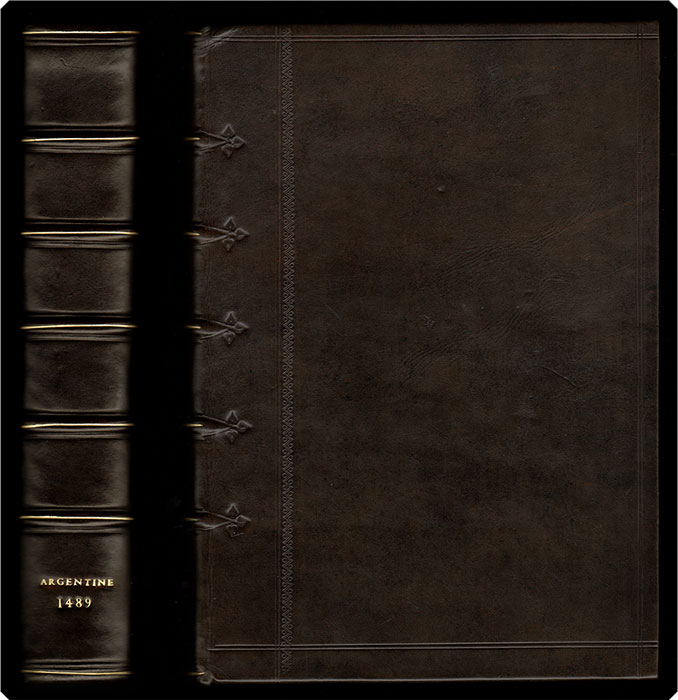
In February of 2012, through another generous gift from our anonymous donor, we purchased the library’s fourth incunable. (Incunabula are European printed materials from pre-1501. A list of all of our incunabula and early printed books is here.)

Our new acquisition is a 1489 edition of Jacobus de Voragine’s Aurea Legenda, i.e. the Golden Legend. It’s in Latin and tells the life stories of Christian saints. The printer is Georg Husner of Strasbourg. (If you’re wondering why a book published in Strasbourg has “Argentine” in its colophon and on its spine, the answer is that the Romans referred to Strasbourg by its military name, Argentoratum, which became Argentina in medieval Latin.)

This particular copy is in a later binding and has almost all its hand-done initial letters. At least one previous owner made marginal notes on several pages. It will be useful to scholars of medieval history (the text was originally written in the 1200s) and to anyone interested in book history.

We could afford our new incunable because it lacks four leaves and has stains and other flaws — all of great interest to anyone interested in books as objects, so we’re very pleased with the bargain! We know faculty and students will make good use of it in the years to come.

More soon on other purchases made with this same anonymous gift!
Mini-libraries in NYC phone booths

New York City architect John Locke proposes converting neglected NYC phone booths into tiny little libraries. According to this article, “Using donated books, Locke tried a first version in one uptown neighbourhood that was promptly cleared of books in six hours and had the shelving stolen in a little over a week. His second version in another neighbourhood eight blocks south and pictured above, fared much better, thanks to the change of location and the addition of a Dewey-like organization system and official-looking DUB logo.” Thanks, Dina Wood!